
Shop Frayze Apparel
This Store is an example of one of Frayze's Services for Your Business
Filter:
Filter:

Products are unavailable at the moment.
Don't worry, they'll be popping up soon with a surprise.

Let's Make Your Vision A
Reality
At Frayze Technologies, we specialize in customizable promotional items designed to elevate your brand's visibility. With a wide range of products tailored for effective marketing campaigns, we empower businesses to make a lasting impression on their audience and can sell warehouse or set you up for Drop-Shopping.
At Frayze, our mission is simple: to provide a full suite of complete, innovative marketing solutions that meet and exceed our clients' needs. From branded apparel to tech gadgets, AI, SEO, Websites, or Custom Development, we offer a diverse selection of practical and memorable services and tools for every occasion.
Your Customizable Marketing Merchandiser
Elevate Your Brand and Leave a Lasting Impression with Personalized Promotional Solutions Tailored to Your Business Needs. Stand Out in the Market, Engage Your Audience, and Drive Results with Customizable Merchandise from Frayze Technologies.
Shop By Categories
Discover the perfect promotional items to elevate your brand and leave a lasting impression with our Shop by Category section. Whether you're looking for branded apparel, tech gadgets, office essentials, or eco-friendly products, we have everything you need to make a statement in your marketing campaigns.


What Client Our Says About Us
Frequently Asked Question
Welcome to our FAQs section, where we address common questions and provide helpful answers about our services as a marketing merchandiser specializing in customizable promotional items. Whether you're new to promotional merchandise or a seasoned marketer looking to enhance your brand's visibility, our FAQs are here to provide clarity and guidance.

Can I customize the promotional items with my company logo?
Yes, we offer customization options to showcase your brand identity.
What types of promotional items do you offer?
We provide a diverse range of customizable merchandise for marketing.
What is the minimum order quantity for personalized items?
Minimum order quantities vary depending on the selected product.
How long does it take to receive my customized items?
Production times vary but are typically within 7-10 business days.
Do you offer rush shipping options for urgent orders?
Yes, we offer expedited shipping options for time-sensitive orders.
See Our Latest Blogs
Stay up-to-date with our latest insights, tips, and trends by diving into our newest blogs. Whether you're seeking industry expertise, marketing strategies, or product inspiration, our blog section is your go-to resource for valuable content.
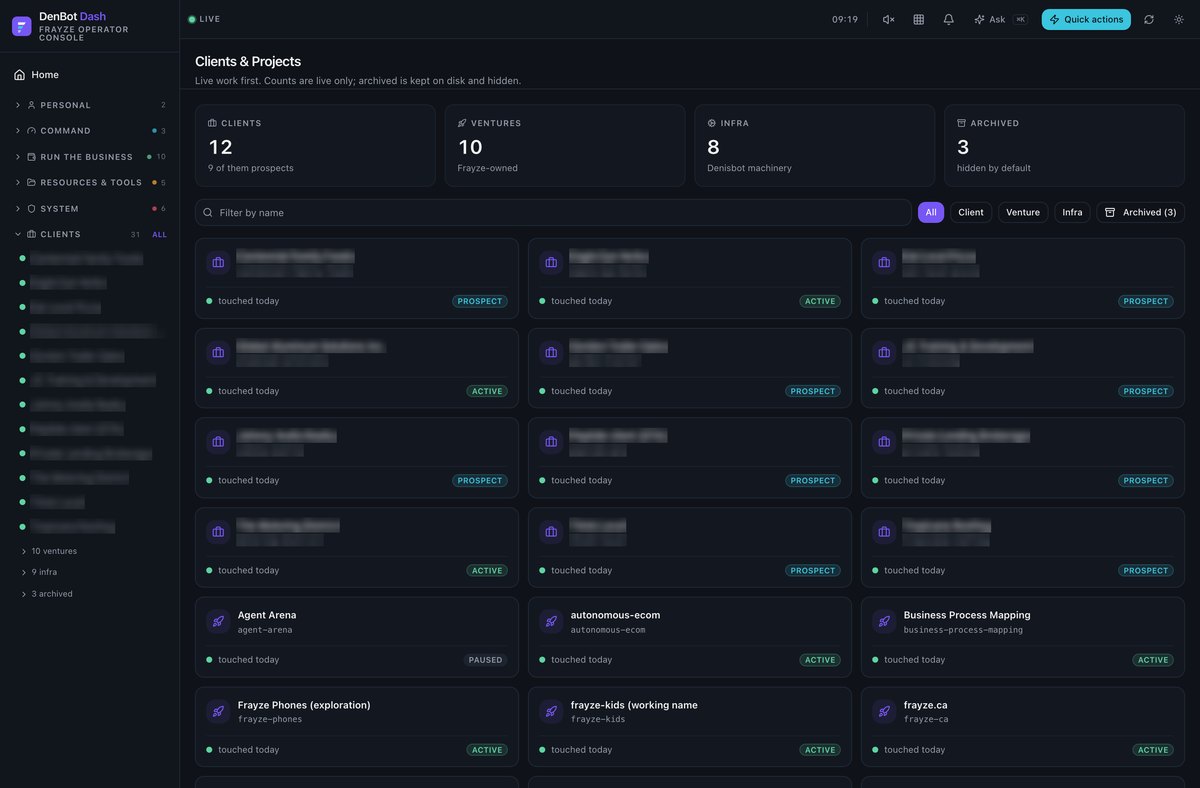
One Screen, a Dozen Businesses: Inside a Working AI Operating Layer
Every agency says it uses AI now. Almost none of them will show you the screen.
So here is ours, with the client names blurred and nothing else touched. This is the console we run Frayze from: client work, our own ventures, the infrastructure underneath, and the scheduled jobs that keep all of it honest.
This article is the long version. It covers what an AI operating layer actually is, the three things that make one work, how it gets built without burning a year, what it costs to run, and what the small version looks like for a business that is not an agency.
Key takeaways
- An AI operating layer is not a chatbot. It is written-down context, repeatable procedures, and jobs that run whether or not anyone remembers them.
- The compounding asset is the procedure library, not the model. Ours is 188 capabilities across six pillars, and 39 of them have been hardened into deterministic code.
- Trust comes from auditability. The system files tickets against itself, gates every write to a live client system, and reads the write back to prove it landed.
- Most businesses need three automations, not twenty-two. Answer the missed call, capture the lead where you will see it, follow up without being reminded.
- Speed at the end comes from months at the start. The console was assembled in a couple of days on top of a system we had been building for months.

Thirty-one live workspaces in one place: twelve client businesses, ten ventures of our own, eight pieces of internal machinery, and one still waiting to be classified. Counts are live. Archived work is kept on disk and hidden so it cannot pad the number.
What an AI operating layer actually is
Most AI marketing platforms are a text box with a subscription. You ask, it writes, you paste. That is a tool. It helps for ten minutes and forgets you exist.
An operating layer is different in one specific way: it holds state. It knows who your clients are, what you charged them, what you promised, what broke last time and what the rule is now. Then it acts on a schedule instead of on a prompt.
The distinction matters commercially, because only one of the two compounds. A tool gives you the same ten minutes back every time you use it. An operating layer gets more capable every month whether or not you are looking at it.
The three parts that make one work
Strip away the branding and every serious implementation has the same three components. Miss one and the whole thing degrades into a chatbot with extra steps.
- Context that survives. One linked body of knowledge holding every client, decision, price, guardrail and past mistake.
- Capability that accumulates. A library of procedures that get reused and progressively hardened into code.
- Work that runs unattended. Scheduled jobs that report to a heartbeat, where a job that fails silently is treated as a failure rather than a success.
1. Context that survives
The reason most AI pilots stall at month three is not model quality. It is that nothing the assistant learns on Monday is available to it on Friday. Every session starts from zero, so a human has to re-explain the business every time, and re-explaining the business is the actual work.
The fix is unglamorous. Everything gets written down in one place and cross-linked: client profiles, pricing decisions, compliance rules, the post-mortem on anything that went wrong. Today that is 11,438 nodes and 15,592 edges across 1,173 clusters.

Every skill, rule, memory, reference document and code module, linked. This is the difference between an assistant that helps and an operator that knows your business.
That graph is queryable, which is the part that pays. Before any non-trivial task, the system asks the graph where the relevant knowledge lives and reads only those lines. It is cheaper than searching from scratch and, more importantly, it means a decision made in March still governs the work in July.
2. Capability that accumulates
188 capabilities across six pillars. Not 188 prompts. These are procedures, hard guardrails and reference material that get reused: how to audit an ad account, how to launch a site, what we will never do to a client database.

Fifty-three percent of the skills now run deterministic code. That percentage going up is the whole strategy. Note the honest panel at the bottom: the system will not show a usage chart it cannot actually measure.
The number that matters on that screen is not 188. It is 39, the count of procedures that have been hardened into actual code. We call it calcification and it is the core of the method:
Do it by hand. Do it twice more the same way. Write it down as a procedure. When the procedure stops needing judgment, turn it into a script so it runs identically every time.
Loose first, then fixed. Judgment is expensive and inconsistent, so you spend it once on the hard version and then never again. This is why the capability count keeps climbing while the attention each client needs keeps falling, and it is the mechanism behind every AI strategy rollout we run for a client.
3. Work that runs unattended
Twenty-two scheduled jobs run on their own schedule and report to a heartbeat. They check that every client site still renders, pull Search Console and flag pages competing against each other, watch publishing queues, and sweep for security issues overnight.

Every job accounted for, no blind spots. Two are red today and the console says so on the front page rather than burying it.
The design decision worth stealing: a job that ran is not a job that worked. Each job has to produce evidence from this run, and the heartbeat reflects the outcome rather than the execution. We learned that the hard way when a social integration returned a success code for eleven days while publishing nothing at all. Green lights that mean "the script executed" are worse than no lights, because they buy false confidence.
What makes it trustworthy enough to point at a client
An automation you cannot audit is a liability. So the system runs a sweep against itself every night and files tickets on what it finds. Most of the queue below is the machine reporting its own bugs.

Forty open tickets, fourteen high severity, and 235 triage decisions on an append-only ledger. Read the titles: a job stuck in a fail loop, a grading step that never produced a grade, a cleanup path that orphaned its own working directory. That is what real self-monitoring looks like.
On top of that sit rules the system is not allowed to cross, and they are the reason this can be pointed at live client accounts at all:
- Writes are gated, then verified. Anything that changes a live client system is confirmed first, then read back to prove the change actually landed.
- Ad campaigns get built paused. Real money never starts spending on an automated decision. A human switches it on.
- Outreach is drafted, never blasted. Canadian anti-spam law is not a setting, and a database someone bought is not a mailing list.
- No invented numbers. If a result is not measured and consented to, it does not appear in a report or on a website.
The same discipline covers infrastructure: eleven domains, their DNS, their proxy state, their build minutes, and what search crawlers actually receive when they ask. That last one is not theoretical. Our own site once quietly served a file that told AI crawlers to go away, and traffic fell for a week before anyone connected the two.

One of these domains is serving a file that blocks every crawler. We know which one, and that is the point: the console reads robots.txt as actually served instead of trusting a setting in a dashboard. We learned that the hard way on our own site.
What it costs to run
Cost is a first-class panel, not an afterthought, because an operating layer that quietly triples its own bill is not a business asset.

Cheap models do the mechanical work and expensive ones are reserved for judgment. The warning across the top is the system telling on itself for drifting from that rule.
The rule is simple: the expensive model designs, the cheap model executes. Bulk classification, extraction and formatting go to the cheapest tier that does the job properly. When the mix drifts away from that, the console says so on its own front page, which is what the warning across the top of that screenshot is.
How long this actually took
The console itself came together in a couple of days. That number is misleading on its own, and we would rather give you the honest version.
It took months to earn those two days. Months of doing client work by hand and writing down what worked. Months of turning those notes into procedures, then arguing with the procedures until they were right, then hardening the stable ones into code. Months of guardrails written the expensive way, immediately after something went wrong.
By the time we built the screen, the hard part was already done. Every panel is reading a system that already existed. That is the actual lesson for anyone considering this: the interface is the last two percent. The compounding asset is the written-down context and the procedure library underneath it, and there is no shortcut that skips the months.
What the small version looks like
Strip out everything that only an agency needs and the useful core gets small fast. Almost nobody needs twenty-two scheduled jobs. Most businesses need three.
| The gap | What runs instead | Where it applies |
|---|---|---|
| The call comes in while you are on a roof, under a hoist, or with a customer | Missed-call text back and an AI receptionist that answers instead of a voicemail | Trades and installers |
| The lead lands in a form, an inbox and a DM, so it gets answered tomorrow | One CRM with speed-to-lead routing and follow-up that fires on its own | Dealers and service businesses |
| Hundreds of old enquiries and past customers sitting cold in a database | Database reactivation to the contacts you already have a relationship with | Any business past its first year |
| Good work, invisible online, no recent reviews | Local SEO and reputation management on a schedule | Local service businesses |
None of that requires the console above. It requires the same idea at a smaller size: your context in one place, the repeatable work automated, and one screen where you can see it. The full platform breakdown covers each piece, and the case studies show what it looks like once installed.
The honest part
We left the red on the board on purpose. Two jobs are failing. Forty tickets are open. One job has been emailing about twice as often as it is supposed to.
An all-green dashboard usually means nobody is looking at it. Ours gets watched every day, which is exactly why it has warts. Anyone showing you a perfect screen is showing you a demo, and a demo is a promise about a system rather than the system.
Frequently asked questions
Is this just ChatGPT with extra steps?
No. A chat assistant answers when asked and forgets afterwards. An operating layer keeps a written record of your business, runs work on a schedule without being asked, and refuses actions that break a rule. The model is a component, not the product.
Do I need something this big?
Almost certainly not. This console exists because we run a dozen workspaces at once. A single business usually needs three automations and one place to see them. Start with the one job you keep forgetting to do, and see our pricing for what a normal build looks like.
How long does an implementation take?
A first working system is a matter of weeks, not months, because we are installing patterns that already exist rather than inventing them for you. The part that takes longer is the same part that took us months: deciding what your rules are and writing them down. Our AI strategy rollout is built around that sequence.
Is it safe to let software touch my CRM and ad accounts?
Only with gates. Ours builds campaigns paused, confirms before any write to a live system, reads the change back to verify it, and keeps an append-only record of every decision. If a vendor cannot tell you what their automation is forbidden from doing, that is the answer.
Is there funding for this in Ontario?
There are AI adoption programs that may apply, and eligibility is decided by the program rather than by us. We wrote up the Northwestern Ontario AI adoption grant separately, including who it is actually for. Confirm eligibility with the program before counting on it.
Do I have to be in Thunder Bay?
No. We are based in Thunder Bay and work across Ontario and North America. Being outside a major centre is closer to an advantage here, which we covered in the Northern Ontario AI advantage.
Keep reading
- AI automation for Ontario small business, the practical starting point if this article was the theory.
- Why most small-business CRMs fail within 90 days, which is the context problem in a different costume.
- Speed to lead, the single highest-return automation for most service businesses.
- What an AI receptionist actually handles, and where it should hand off to a human.
- Canada's AI strategy for small business, the wider picture.
Where to start
If you want the short version of all of this: your context in one place, the repeatable work automated, and one screen where you can see it. Start with the one job you keep forgetting to do.
If you would rather see where the gaps are before spending anything, the digital audit is the honest first step, and who we are explains why an agency in Thunder Bay ended up building its own operating layer instead of buying one.


About Us
Brand your success with personalized promotional merchandise that captivates your audience.
Contact Us
202 Franklin st. North, Thunder Bay Ontario P7C4H9
Phone: (807) 700-0079
Email: [email protected]
Copyright© 2026 Frayze Technologies - All Rights Reserved.
Facebook
Instagram
Youtube
Website
LinkedIn